
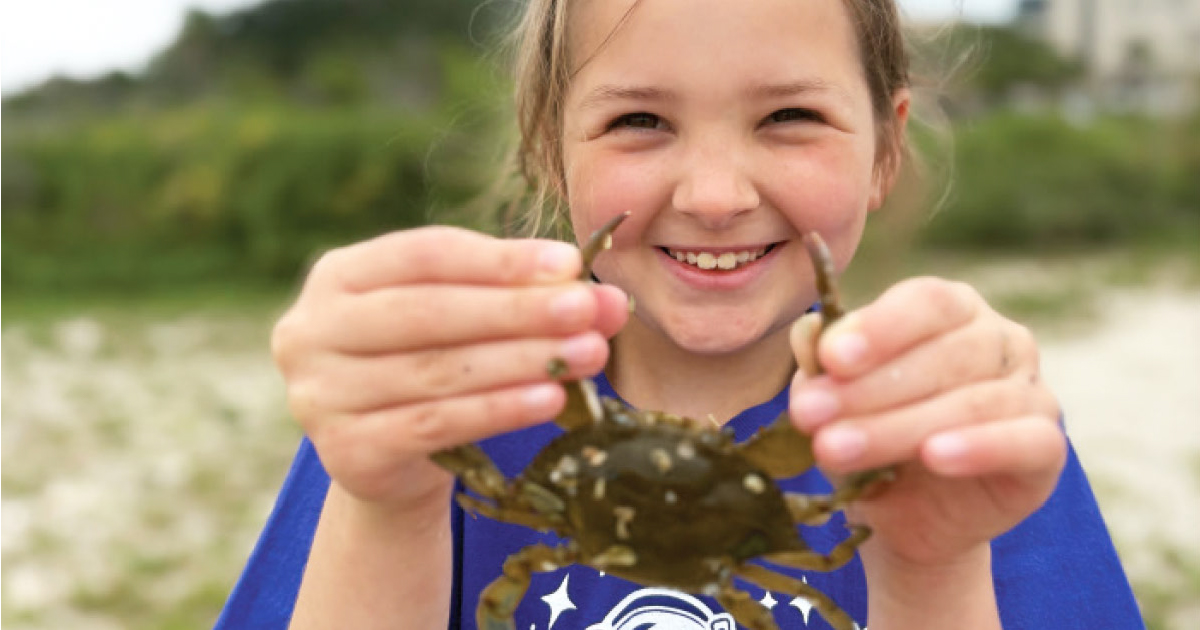
Kimberly McCallum is a second-grade teacher at Liberty STEM Elementary in Sapulpa, Oklahoma.
In her role leading the STEM club, she established and has grown the district’s travel program to three trips per year with students in elementary and middle school—including a drive down to NASA in Texas, and flying trips to places like Maine, Alabama and South Dakota.
Her STEM on the Road trips provide opportunities and experiences that cannot be matched in the classroom. Students get hands-on experiences that increase engagement and understanding, develop critical thinking and problem solving, and encourage creativity. “All that they see and do brings clarity to previous learning and provides a foundation for future topics,” McCallum said.
Why STEM for these trips?
Our students, we’re in the middle of Oklahoma. They read about an ocean, “okay, it’s salt water, okay, the waves are strong, there’s a tide.” But when we’re in Galveston, and they get hit in the face with a wave, and they taste the salt water, and they feel the power, and they see the tide going in and out, when they come back and read about that, they understand it in a whole different way than they ever did before. And that’s why I started the trips. We were made a STEM school in 2014 or something. So, that’s how I tied it in and tried to sell it to administration. If they had made us an art school, I’d be trying to go to New York to the theater.
Do you have a strong memory of seeing that learning in action?
We went to South Dakota in 2021, to Sanford Underground Research Facility in an old mine, and when they took over this space, they had to figure out how to transport supplies up and down, and that was one of their challenges. So, they split our kids into teams, and they said, “Here’s your challenge, you need to design a device that will travel down, travel back up. It’s got to become level with this, so you could roll supplies on and get them down and out,” and things like that. And yes, it was a very small scale, done out of straws and paper and tape and tubes and things, but it was a very practical problem they actually have, and gave our kids on a smaller scale.
Your first trip was to Maine. Why was that chosen?
I love to travel myself, so if I’m going to teacher trainings, I’m always looking for travel with it, and I happened to find one at a place called the Ecology School in Maine, and convinced a couple friends to go with me. So, we went one summer, and it was really great, because it talked a lot about getting kids outdoors for lessons and things like that, not just going outside with your books. I mean, I tied it into the classroom where we were doing measurement, and the curriculum had us putting tape lines on the floor to measure, and I’m like, “This is silly.” So, we went to the park that’s next door, and I’m like, “I want you to go find three items. One must be smaller than your hand, none of them can be longer than your arm.” And so we found those, we measured them, we drew them, we classified them as man-made or natural. We got to tie in so much more because it wasn’t a tape line on the floor.
But anyway, the school in Maine offered another training in winter, and one of the things that you do while you’re there is you come up with an action plan, and our action plan was to bring a group of kids to their week-long ecology school. We approached the superintendent, and this was the first trip that incorporated other elementaries in our district, and so we took half from our school, half from their school. But that’s why Maine, because we go specifically to River Bend Farm to the ecology school.
What are some of the different challenges and highlights of traveling with younger ages?
I’ll start letting them go in second grade, so our youngest kid has been seven that we’ve taken. But because they’re so young, they will pretty much try anything, they’ll do whatever you ask, they’re respectful. In second grade, you still have a little bit of the hero worship thing with their teacher. And as they get older, you know, develop more of the independence, and some of those things that are good, but can not play out so well.
We don’t allow devices on our trips, so they’re not bringing cell phones, they’re not bringing iPads, so they’re really engaging with each other in their environment. And you know, some people think about homesickness with the little ones, it’s actually our older ones that haven’t been before. If they start going in second grade, they’re grand. There might be a few tears as they say goodbye, but by the time we’re two miles down the road, they’re chatting with their friends and laughing, they’re fine.
Our very first trip, we left at about three, four in the morning, and we had made it maybe an hour down the road, and we drove through a town that’s a little bit bigger than ours, and they’re like, “Is this it, are we here?” And I was like, “Oh my goodness, this may be the worst idea I’ve ever had. We’ve got hours to go.” But as we came back, same group of kids, four days later, the questions changed from “are we there yet” to, “What time will we get home? How many more miles is it?”
And then our older kids, fourth, fifth grade, they’re stepping up and being leaders with our second and third graders. That’s one of my favorite things about the trips, is the relationships that develop between the kids who aren’t in class together. And so a fifth grader, when we get back, will come to my room to deliver a note from the office, and they’re like, “Can I go give my friend a hug?” And it’s their little second grade friend, because that was their buddy on the trip, and I didn’t assign a buddy. They did that themselves. You know, the older girls will fix the younger girls’ hair. You get a family feel.
As a Title I school, fundraising is crucial for these trips. Can you talk about what’s worked for you?
We do a lot of fundraising. The first year, parents only had to pay $40 for the trip, and we fundraised everything else that’s gone up. Thee bus driver was free, because it was our principal, so that was a huge expense that we didn’t have to pay. And then we had a donation, and that’s when we added what we call our “flying trip.”
I try to do very little selling, because most of the time it’s really overpriced and not what anybody wants anyway. Some of our most successful events, we do a daddy daughter dance, open to our students but also anybody in the community. We do a books and bingo night, where our students get to earn free bingo games through a reading program that we have, and the parents bring them because they’ve got free games to play, and then the parents buy games for themselves, plus the concession stand, and that does pretty well. And we’ve had a long running partnership with the local Masons and local businesses.
This is an extended version of the interview from the September 2026 edition of Teach & Travel.
Written by Josh Veal, Managing Editor.
Photo courtesy of Kimberly McCallum.


